
The climate emergency does not affect everyone equally. When El Niño brings droughts, floods, failed harvests and soaring food prices, women are impacted most. They are the first to go hungry, they carry the burden of keeping their families alive, they have limited access to vital sanitary supplies, and they can lose their livelihoods that they depend on.
Too often women are ignored, and support arrives only once disaster has struck – after lives and livelihoods have been lost and families have been forced to flee their homes. Climate change is sexist, because the systems that shape its consequences are sexist.
In the coastal village of Ruhita, Bangladesh, women are disproportionately affected by a lack of safe drinking water, and little attention is being paid to the health consequences. Drinking water is contaminated as seawater seeps into wells and rivers.
Rahima, a fisherwoman and president of a women’s leadership group, is speaking out and taking action.
When fresh water is contaminated by salt
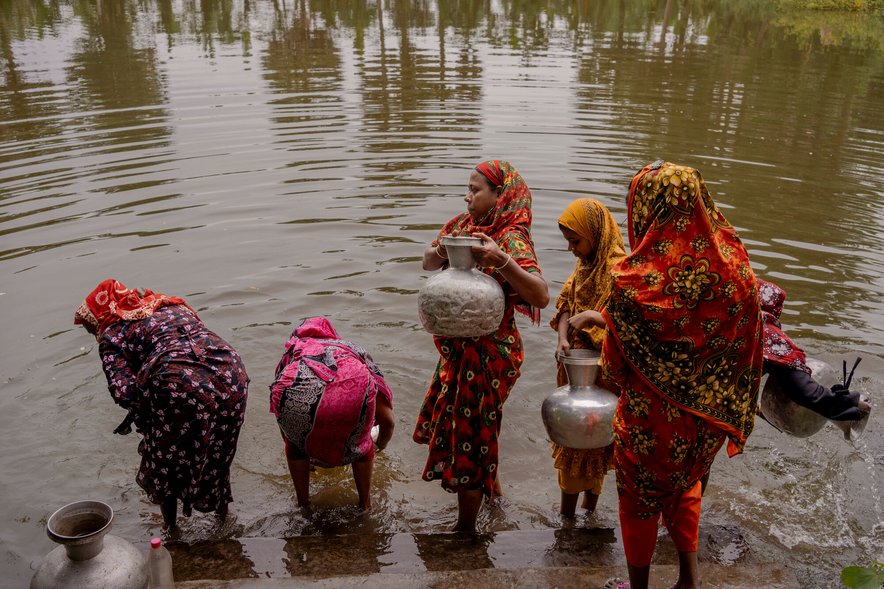
“Health problems are on the rise because of salt in the water and climate change: itching, skin diseases, cholera, and diarrhoea. Women are losing their babies,” warns Rahima.
In Ruhita, where Rahima lives in southwestern Bangladesh, water is everywhere. But drinking water is scarce. With rising sea levels and saltwater intrusion, many water sources have become unfit for consumption. For families, this means a daily struggle: where can they find water that they can drink?
Rahima and the other women in the village often have to walk nearly two kilometres from their homes to find it.
“Carrying water is heavy and difficult and sometimes, many men harass us during our commute. We don’t feel safe.”
The climate crisis increases health problems and forced marriages
For Rahima and other women in Ruhita, climate change exacerbates the workload and inequalities that women already face. But the impact goes far beyond the time spent walking.
“I have spent most of my life in salt water, from my days fishing, to taking a bath in the evening, and even when I do the dishes, I do it with salt water,” says Rahima.
The impact of salt water on women’s health has been documented for several years, with pregnant women facing potentially serious complications during pregnancy through an increased risk of gestational hypertension and preeclampsia. In addition to these health challenges, the climate crisis is contributing to an increase in forced marriages due to loss of income, and societal concerns that health issues will prevent girls from marrying in the future.
Why women’s leadership is a climate solution
This is where Rahima’s leadership becomes particularly important. As president of the Payra Women’s Development Group, she participates in the Women Lead in Emergencies programme led by CARE. The goal is to support women to come together during times of crisis, better understand their rights, and collectively present their demands to the authorities.
Their request to authorities is clear: to restore the water filtration system that once served about 150 families. The filtration system supported women in Ruhita with hundreds of everyday tasks: drinking, cooking, washing, and caring for children. Resetting the system will also mean the women would no longer have to spend hours walking to fetch water.
For Rahima, this mobilisation has made a huge difference:
Before, I couldn’t even leave my house alone. I couldn’t talk to people or make decisions within my own home. Now, together with the other women, we’re making our voices heard without fear.”
A message to world leaders at COP31
For CARE, which has been working to combat the impacts of climate change for 50 years in more than 100 countries around the world, climate adaptation is not just about building structures or providing tools. It’s also about ensuring that the people affected play a meaningful role in decision-making.
In Ruhita, women are simply asking to be able to live, make decisions, and build their future. With COP31 currently underway in Türkiye, Rahima has a message to world leaders:
“We live in the far southwest of Bangladesh. There are no villages beyond us. We live with saltwater and the constant ebb and flow of the tides. Pay attention to the people living in this small, isolated corner of Bangladesh. We need opportunities and support.”
Frequently asked questions
Why is sea-level rise a problem in Bangladesh?
In coastal areas, saltwater intrusion makes access to drinking water more difficult. It also affects certain agricultural activities and people’s livelihoods. The salinity of the water can also have health consequences for those exposed to it.
Why are women particularly affected by climate change?
Women often shoulder a significant share of the tasks related to providing water for their families. When water becomes harder to find, the distances they must travel and the time spent on this task increase. They may also be exposed to specific risks to their health and safety.
What can be done to combat climate change?
To combat climate change, we must first and foremost reduce greenhouse gas emissions and accelerate the transition to cleaner, renewable energy sources.
We must also adapt to the consequences that are already unfolding: protecting water resources, preserving the ecosystems on which communities depend, and supporting the most vulnerable regions.


