
Across the world, humanitarian aid workers risk their lives to help others. Yet, record numbers of aid workers are being targeted in violent attacks, with another grim milestone passed in 2025: 907 humanitarians were killed, injured or kidnapped. So far in 2026 alone, 82 aid workers have been killed, 97 injured and 39 kidnapped. World leaders are failing to hold those responsible to account with most attacks never fully reported, investigated or prosecuted. We refuse to accept this. Those who work tirelessly to save others must be supported.
This World Humanitarian Day, CARE International celebrates humanitarian aid workers across the world. We hear from colleagues in Lebanon who are risking their lives every day to support their communities, and who are committed to kindness and compassion in the face of crisis - despite the risk of being a target themselves.
Hiba’s story: “It hits different when you’re a mother of small children”
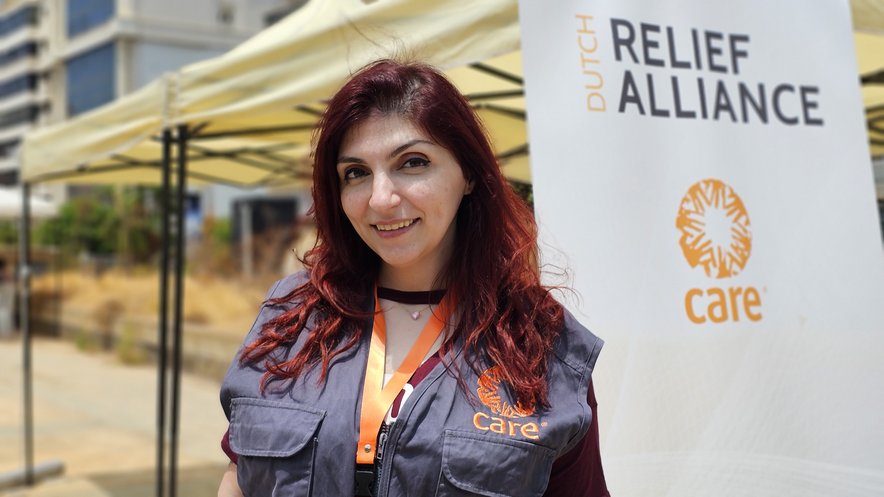
“I lived through five wars...I know what war is. I know what displacement is. I know what it means to lose everything. My earliest memory is of my father carrying me down the stairwell to a safe room”
For Hiba, conflict is not just part of her work - it has shaped her entire life.
For the past 13 years, Hiba has worked as a humanitarian aid worker in Lebanon. She specialises in emergency response, supporting people forced to flee their homes with little more than the clothes they are wearing.
Every day, she meets women trying to piece their lives back together after losing everything. She listens to their stories, helps them access essential support, and stands beside them as they begin to rebuild their lives.
Then she goes home to the same reality.
“It hits different when you’re a mother of small children and war breaks out. I was scared leaving my children at home, but I had to go to the office and keep working. I am a frontline worker, I am needed, but my sons need me as well.”
The escalation of war in Lebanon this year forced her to flee with one of those sons in her arms.
“I did not know where to go. I had my baby in my arms and there was smoke everywhere. I did not know where to turn: The bathroom? The stairs? The street? The voices were so loud.”
“You can hear the plane coming above you. Hear it fire. You do not know where it will drop. Then you hear the hissing when the missile flies through the air. The loud boom of the impact. And then the building collapsing.”
“When the bombs fall, my three-year-old calls out: 'Mommy, mommy, it is thunder.' And I answer: 'Yes, it’s thunder.' But then he looks out of the window and asks why there is no rain. And I say that it might just be fireworks. He is too small to understand war.”
She remembers being that child herself.
“Whenever there was war, when I was a child, my father would bring out the mattresses into the corridor and lay them close next to each other. We slept as a family. I felt safe like that. It is a good memory, as I did not understand war then.”
The overlap between Hiba's professional and personal life is profound. She understands the fear, uncertainty and grief that the women she supports are experiencing because she is living it herself.
Despite everything she has experienced - Hiba refuses to lose hope.
She is determined that even in the darkest moments, kindness, compassion and standing beside another person can help them find the strength to keep going. To rebuild and create a better life.
Eliane’s story: “Even in the quiet moments, the war never truly leaves you”
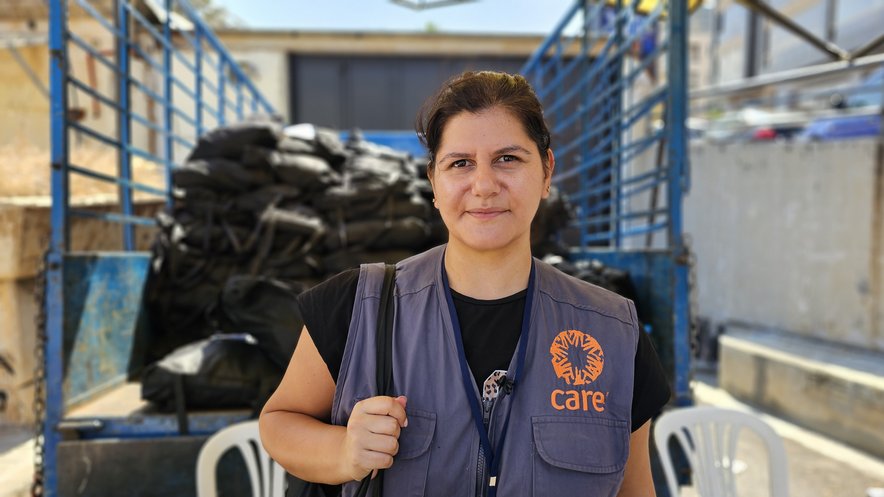
Eliane, CARE International in Lebanon’s Gender and Protection Manager, describes how she has learned to live alongside the bombs.
“As humanitarians, we work in a field where we are affected ourselves."
"The constant buzzing of drones, day and night, accompanies every part of my life. It punctuates everything I do, at work and outside of work. It’s a constant source of stress and a relentless reminder that the war is still here. I go to work, run errands, and carry on with daily life, yet the sound never leaves. Somehow, though I’m not sure how to describe it, I’ve learned to live alongside it."
“The sonic booms of fighter jets are even more triggering than the drones, especially having lived through the Beirut port explosion."
Like Hiba, her personal life is entirely intertwined with her professional life. She describes how even moments of silence bring fear, rather than peace.
“Every blast brings back memories I wish I could leave behind. When the workday ends and I go home hoping to rest and process everything I’ve witnessed, I can’t, my mind fills with endless questions, worries, and memories. Even in the quiet moments, the war never truly leaves you. Even silence feels dangerous, I worry about putting in my noise-cancelling headphones to block out the sound of war, because I need to know if something happens close to me."
“Every day I listen to women who are trying to stay strong for their children and older people who are reliving the trauma of previous wars… listening to these stories of trauma is never something you truly get used to."
"But who are we without our empathy? If we become numb, we lose an essential part of our humanity. These are my people. That is why we keep showing up every day.”
Whether in Lebanon, Gaza or Ukraine, nobody should have to go to work with a target on their back. Add your name to stand with aid workers everywhere – demand that world leaders protect them, and hold those responsible for attacks to account.


